|
Starting
from primordial concepts of the occidental rationale formation, the opera
"Machina Mundis" intends to artistically comment the primitive relations
between art and science in a time in history where these elements blended
with metaphisical concepts.
The 17th
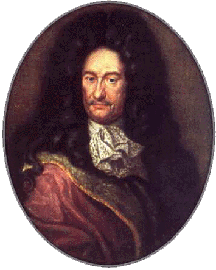
century German thinker Gottfried Wilhelm Leibniz embodies perfectly this
goals: thinker, philosopher, ambassador, librarian, mathematician, astronomer,
mistic and visionary.
His contributions
span from humanistic critics on Descartes' rational philosophy, to the
invention of numeric calculus, passing through his diplomatic attempts
at a reunification of protestans and catholics.
In 1675,
serving as an ambassador at the court of Louis XIV - the Sun King - he
wrote a recently discovered text entitled 'Drôle de Pensèe'
(bizarre thoughts). In it he dreams a permanent event - the 'representation'
- where cosmology, art, circus, theatre, panting, botanics, martial arts,
etc. or 'all the conquests of the human imagination' would be united at
an exposition open to the public or selected groups.
These
representations' goal would be to broaden the immaginative/perceptual horizon
of the spectators, as well as to provide monetary income to artists, scientists
and all creators of new proposals.
|